
Sex Offender Checks in Virginia Beach City
The Virginia Sex Offender and Crimes Against Minors Registry is the main public source for Virginia Beach registry records. Virginia State Police maintains it under Code of Virginia Title 9.1, Chapter 9. The system searches by identity or geography and costs nothing to use. It can support personal, family, and community safety, but a listing is not a finding that a person poses a present danger. Virginia State Police says the registry is not a risk-assessment product.
Virginia Beach Police performs local registration. The public registry does not accept a registrant's change as a substitute for contacting law enforcement. VBPD publishes the local PD436S registration form and the state SP236 form. A person with a registration duty should call VBPD for current appointment and location instructions. Members of the public should use the state registry for search and contact police only to report a possible failure to register, not to confront anyone.
Virginia Beach Registry Forms at VBPD
The VBPD permits and records page links the Sex Offender and Crimes Against Minors Registration Form PD436S and Virginia State Police Form SP236. No fee is shown for these forms. Police headquarters is at 2405 Courthouse Drive, Virginia Beach, VA 23456, and the main line is (757) 385-4141. Call before arriving because the research does not establish that every change can be handled without an appointment.
Virginia Beach registration and reregistration duties come from § 9.1-903. Periodic verification comes from § 9.1-904, and § 9.1-905 addresses new Virginia residents and nonresident registrants. A move within Virginia Beach, homeless status, a vehicle change, or another required change must follow the legal timetable and agency instructions. A postal or driver's-license update alone is not a registry update.
How to Search the Virginia Sex Offender and Crimes Against Minors Registry
The official Virginia registry search supports name, SOR number, address, city, county, ZIP code, radius, and map routes. It also includes filters for incarcerated, homeless, and civilly committed status. A Virginia Beach registry search must use the independent city, so a county selector should not lead a reader to invent a separate Virginia Beach County. Search controls can change, and the live application timed out during the research review, so the table reflects functions documented by Virginia State Police.
- Open the official search and read the conditions of use before choosing a search method.
- Use a name or SOR number for a known identity, or an address, city, ZIP, radius, or map for an area search.
- Apply status filters only when they answer the question, then review the list without assuming a pin marks a parcel boundary.
- Open the official profile and compare the identity, location status, offense, tier, and update fields before drawing a conclusion.
| Field or Control | Type | Required | Official Notes |
|---|---|---|---|
| Search method | Tabs/navigation | Unspecified | Name or SOR number; ZIP, address, city, or county. |
| Name | Text | Conditional | Used for a person-name search. |
| SOR number | Text | Conditional | Uses the state registry identifier. |
| Address | Text | Conditional | Basis for a location and radius search. |
| City | Text/list | Conditional | Enter or select a Virginia city. |
| County | Text/list | Conditional | Enter or select a county; Virginia Beach is an independent city. |
| ZIP code | Text | Conditional | Uses a five-digit ZIP code. |
| Radius | Selector | No | Distance choices were not confirmed during inspection. |
| Map | View control | No | Shows a search area geographically. |
| Incarcerated | Filter | No | Identifies registrants who are currently incarcerated. |
| Homeless | Filter | No | Identifies registrants without a conventional residence. |
| Civilly committed | Filter | No | Identifies persons in civil commitment status. |
| Search | Button | Conditional | Runs the chosen query. |
The VSP search interface shows the map and list route used for Virginia Beach location searches.
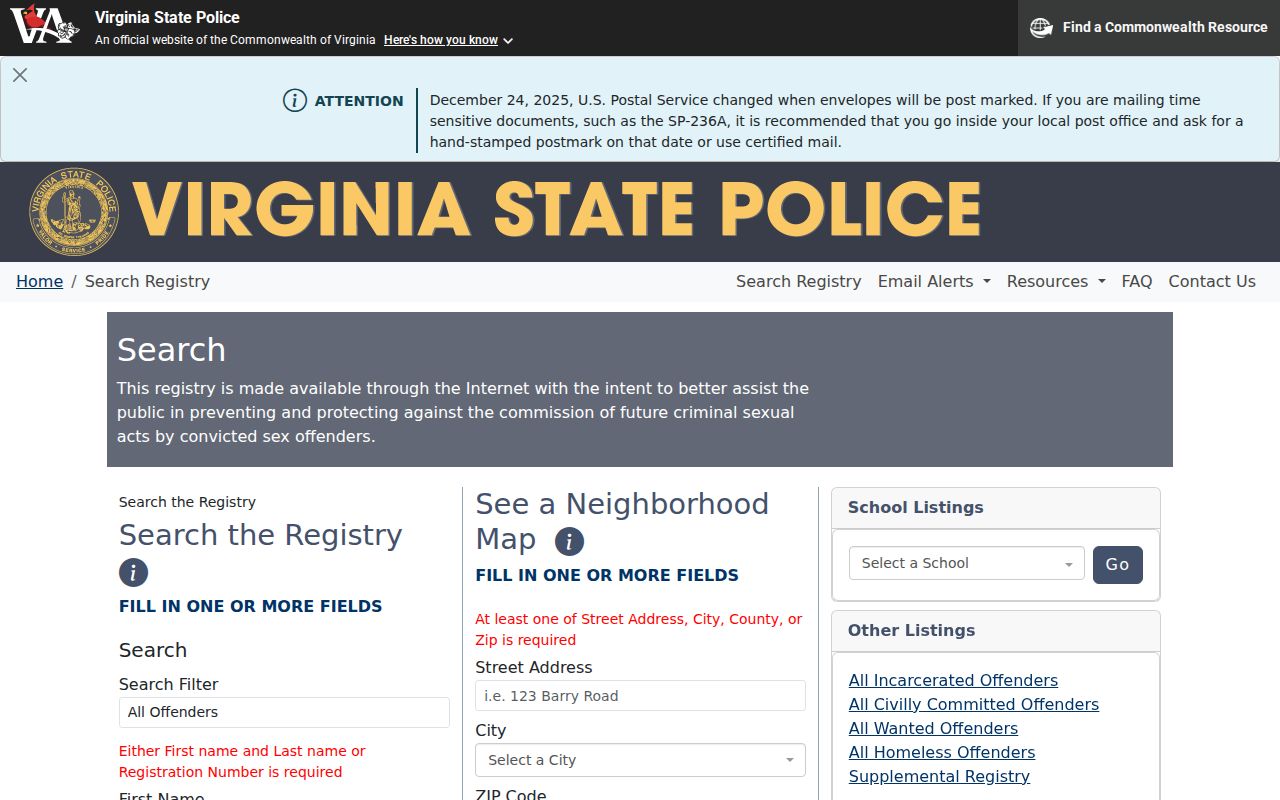
The official interface keeps the place search tied to Virginia State Police data rather than an unofficial map.
Virginia Beach and NSOPW Searches
The Virginia registry is the source of record for Virginia registration information. The National Sex Offender Public Website, run by the U.S. Department of Justice, searches participating jurisdictions across state lines. It is useful when a known address, work route, trip, or family safety plan reaches beyond Virginia. It also helps when a name search may involve another state. NSOPW federates public jurisdiction data rather than replacing Virginia's own record.
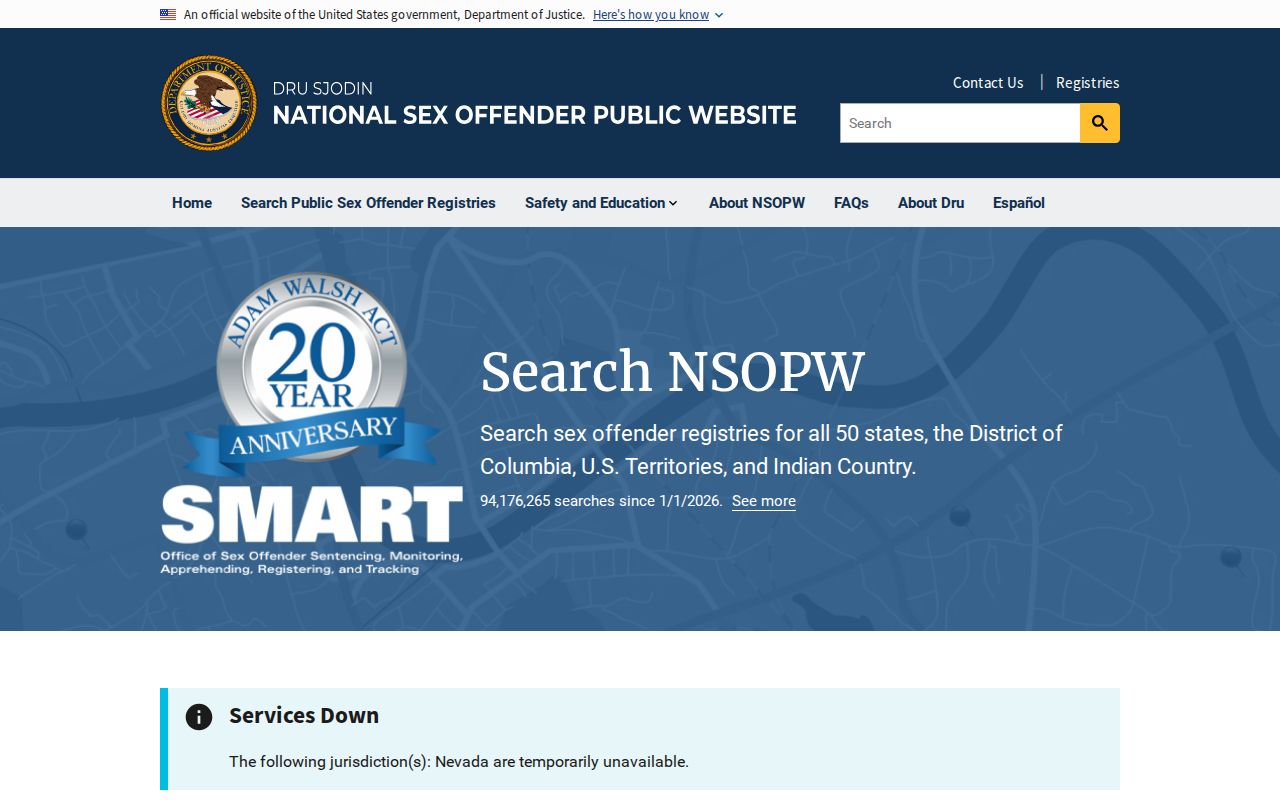
This national search layer is best used beside the Virginia profile, especially when location history or a boundary may involve another jurisdiction.
For Virginia Beach readers, a no-match result is narrow. It does not prove that a person has no criminal history because only people subject to a current statutory registration duty belong in this registry. Court case records and the Virginia State Police criminal-history process answer different questions. Search results should also be checked for name variants and updated status before concluding that a profile is absent.
Inside a Registry Profile
A Virginia Beach registry profile groups identity, location, offense, and registration data. Each field should be read by its own label and date. An offense date is not the same as a conviction date. An alias does not prove current use. “Homeless” is a registration status, not a blank record. Incarceration or civil commitment can change the person's current location without erasing the registration record.
| Identity | Name, aliases, and SOR number or registry identifier. |
|---|---|
| Photograph | Current photograph maintained as part of registration and updates. |
| Physical description | Sex, race, age or birth information, height, weight, eyes, hair, and identifying marks where maintained. |
| Residence and status | Registered address or homeless status, plus incarcerated or civilly committed status where shown. |
| Other locations | Work, school, or higher-education information when authorized as public fields. |
| Vehicles | Vehicle identifying information maintained under § 9.1-903. |
| Offense | Qualifying offense, jurisdiction, conviction or adjudication date, and tier. |
| Registration | Initial registration, verification, compliance, or wanted information when posted. |
| Mapping | A geographic aid for the reported location, not a property-boundary ruling. |
The official VSP registry is the source for the public profile display.
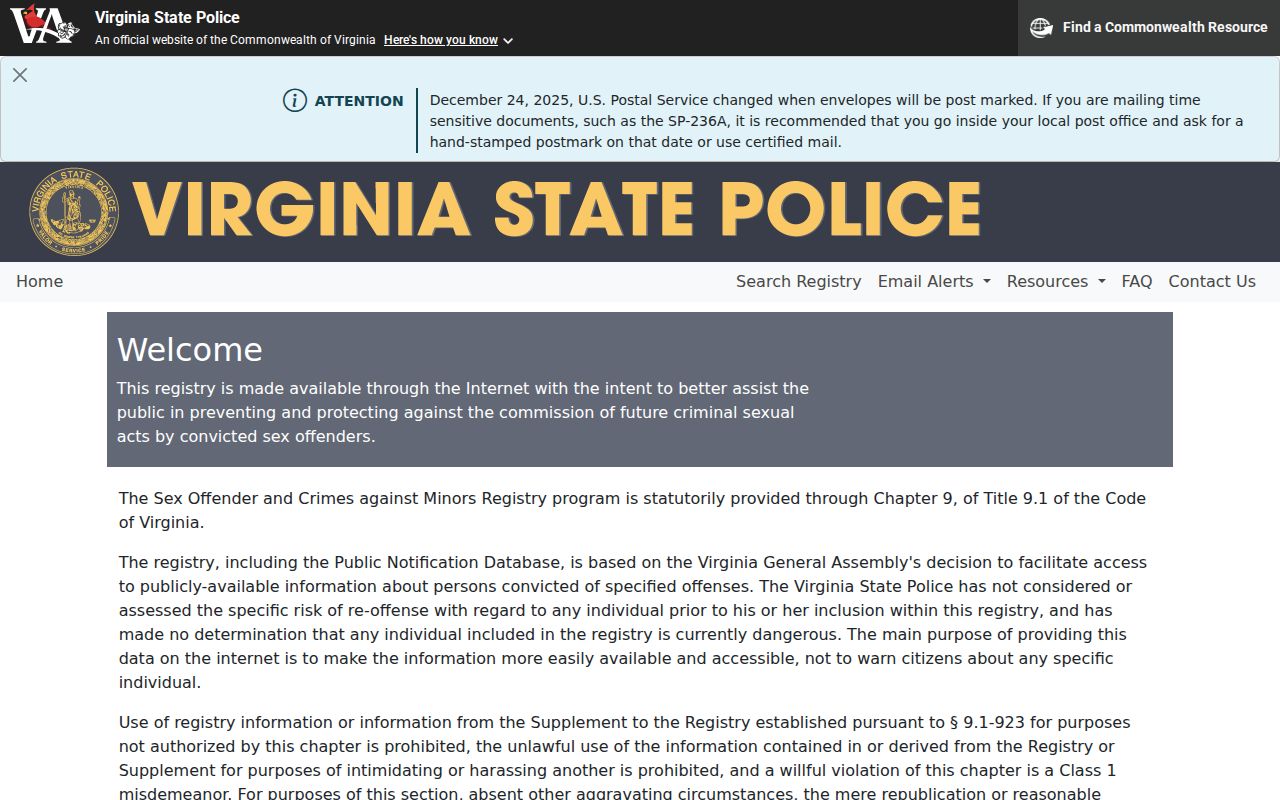
The captured interface is framed around field structure and does not reproduce an identifiable registrant as page content.
Reading Virginia Beach Registry Dates
Offense, conviction, first-registration, verification, and status dates describe different events. The offense date concerns the underlying conduct. The conviction or adjudication date concerns the court result. Registration dates track the later statutory duty. A compliance label reflects registry reporting status, not a fresh ruling on guilt or present risk. Read the official profile before relying on a search-list label or map pin.
A reported address can also have context. The profile may identify residence, homeless, incarcerated, or civilly committed status. Map placement is a visual aid and does not determine a lot line or prove that a person occupies the exact point a base map suggests. If information appears stale, note the profile details and contact the proper agency. Do not confront the person or household.
Virginia Registration Levels and Requirements
Virginia uses offense-based Tier I, Tier II, and Tier III categories under § 9.1-902. They are not Virginia Beach risk scores. Virginia Beach registrants are classified under the same state rules. Substantially similar out-of-state and federal offenses can involve detailed classification rules, so use the tier on the official profile rather than guessing from an offense name. Verification intervals have been affected by 2025 legislation; the current statute and the agency instruction given to the registrant control.
| Virginia Category | Registration Duration | Verification and Public Access |
|---|---|---|
| Tier I | Continues unless terminated by court order under §§ 9.1-909 or 9.1-910. | Periodic verification under current § 9.1-904; check live visibility under § 9.1-913. |
| Tier II | Continues unless terminated by court order; time alone does not cause automatic removal. | Periodic verification under current § 9.1-904; offense-based, not a danger prediction. |
| Tier III | Lifetime continuing duty under § 9.1-908. | Periodic verification under current § 9.1-904; Internet dissemination applies under § 9.1-913. |
| Murder or former § 18.2-67.2:1 | Lifetime continuing duty under § 9.1-908. | Current statutory verification schedule and specific statutory treatment apply. |
Confinement in a correctional facility, hospital, or other covered institution tolls and extends an otherwise applicable period under § 9.1-908. Relief under §§ 9.1-909 and 9.1-910 is court-based. It is not an informal deletion request to VBPD or Virginia State Police.
Virginia Beach Registry Email Alerts
The redesigned VSP registry includes Email Alerts. Virginia Beach alert users should begin at the official registry home, choose Email Alerts, and follow the live prompts for geography and notice choices. The exact required fields could not be verified because the application timed out during research, so they should not be assumed from older forms.
Code § 9.1-914 also governs notice to specified entities and electronic notice to requesting persons. Form SP-285 is a separate route for qualifying schools, regulated or licensed child-care programs, foster homes, family day homes, and group homes. It allows Internet or postal notice and asks for the facility type, name, contact person, email, phone, and mailing details. Virginia VINE handles custody or status notifications. It is not a registry-address alert.
Note: Registry email alerts, SP-285 notices, NSOPW results, and Virginia VINE notifications serve different needs and should not be treated as substitutes.
Virginia Beach Location Rules Vary
Virginia does not impose one universal statewide distance from every school or park on every registrant. Location rules depend on the offense, supervision status, court order, and other legal facts. Code § 18.2-370.5 restricts school-property access in covered situations. Separate probation or post-release terms can limit child contact, movement, or attendance at an event. Registry status alone does not establish the exact restriction that applies to one person.
Questions about a specific supervision condition belong with the sentencing court or the responsible Virginia Department of Corrections office, not with neighborhood guesswork. The registry supports awareness, but it does not publish a complete supervision file. Personal safety plans should rely on current official information and normal emergency channels.
Community Notification and Lawful Use
Virginia Beach registry information is intended for awareness and personal or family safety. For a suspected failure to register, call Virginia Beach Police at (757) 385-5000 for a non-emergency or the VSP Sex Offender Registry at (804) 674-2825. The state registry can also be reached at sor@vsp.virginia.gov or by mail through Virginia State Police CJIS, P.O. Box 27472, Richmond, VA 23261. Use 911 only for an immediate emergency.
Registry misuse is a crime: Code of Virginia § 9.1-918 makes using registry or supplement information to intimidate or harass another person a Class 1 misdemeanor. Section 9.1-919 requires the penalty warning.
If a Virginia Beach profile looks outdated, record the official profile details and report the concern through VBPD or VSP. An agency can check compliance and source data. Public confrontation, threats, or punishment can harm others and violate Virginia law.